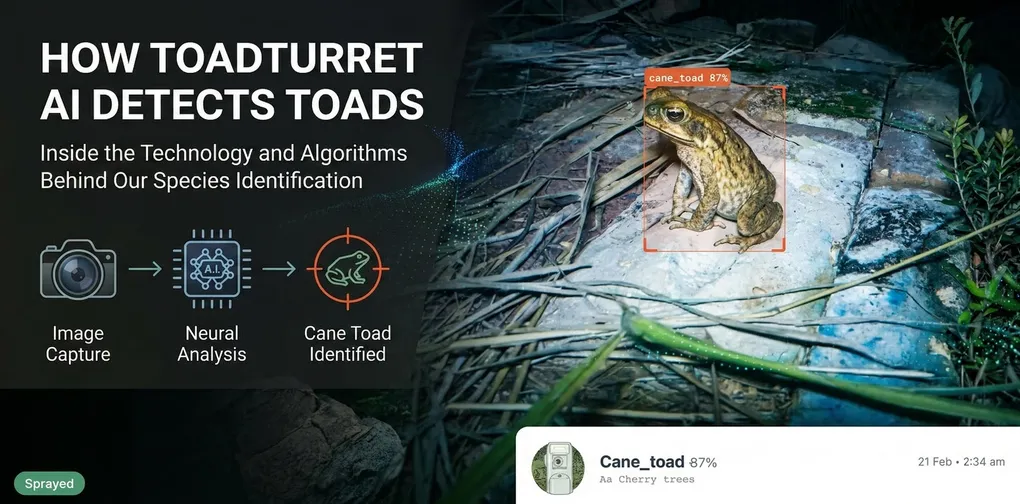
How ToadTurret Detects Cane Toads Using AI
One of the most common questions we get is: “How does it actually know it is a toad?”
The short answer is a camera and an AI model working together. The device scans the area in front of it taking pictures and passing them to an onboard AI. This AI has been trained on thousands of pictures of toads to recognise them with a high degree of accuracy. It also works in tandem with the cloud to run even more powerful secondary checks.
The longer answer is a bit more interesting.
How the Detection Works
The detection process is straightforward, even if the technology behind it is not.
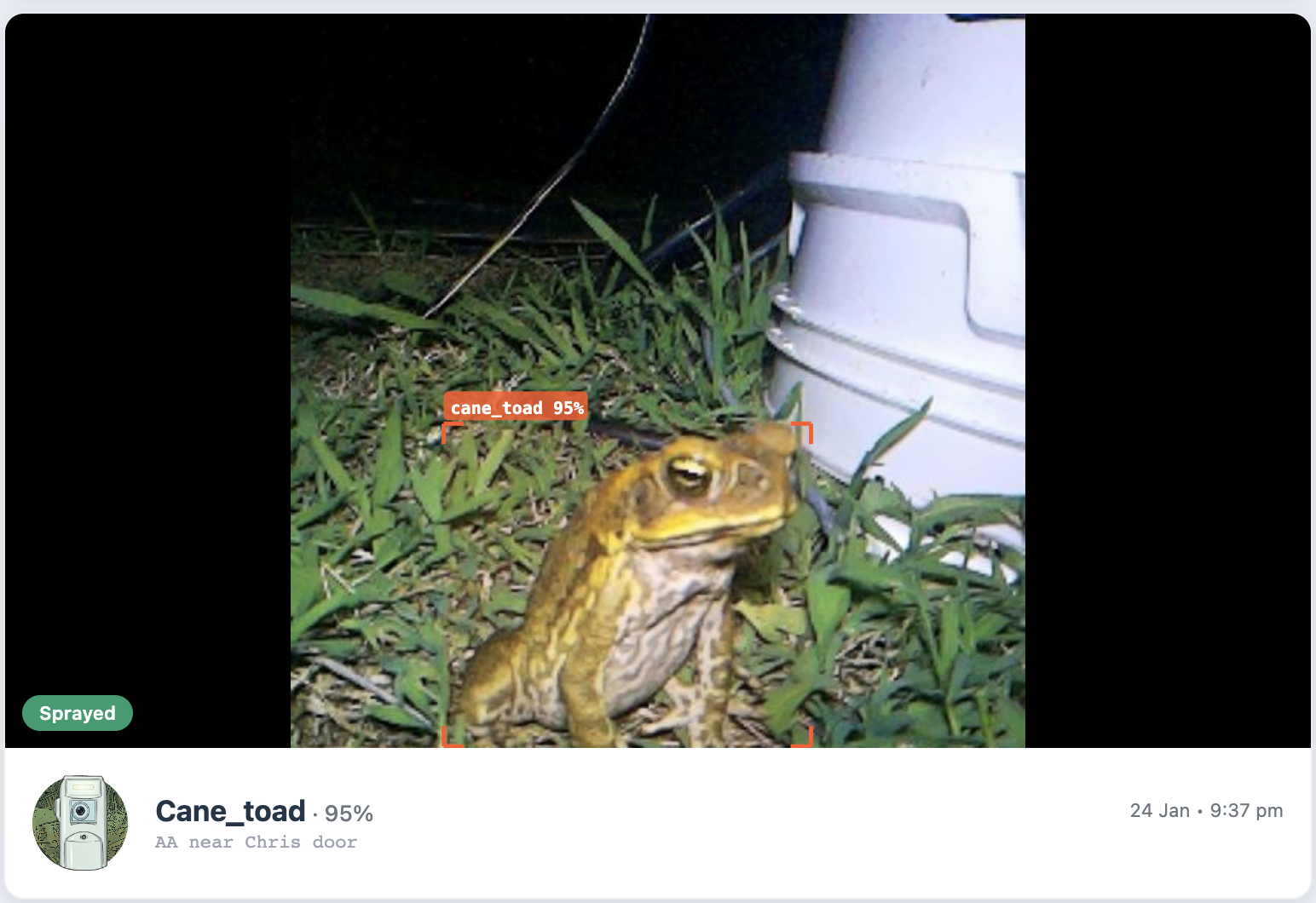
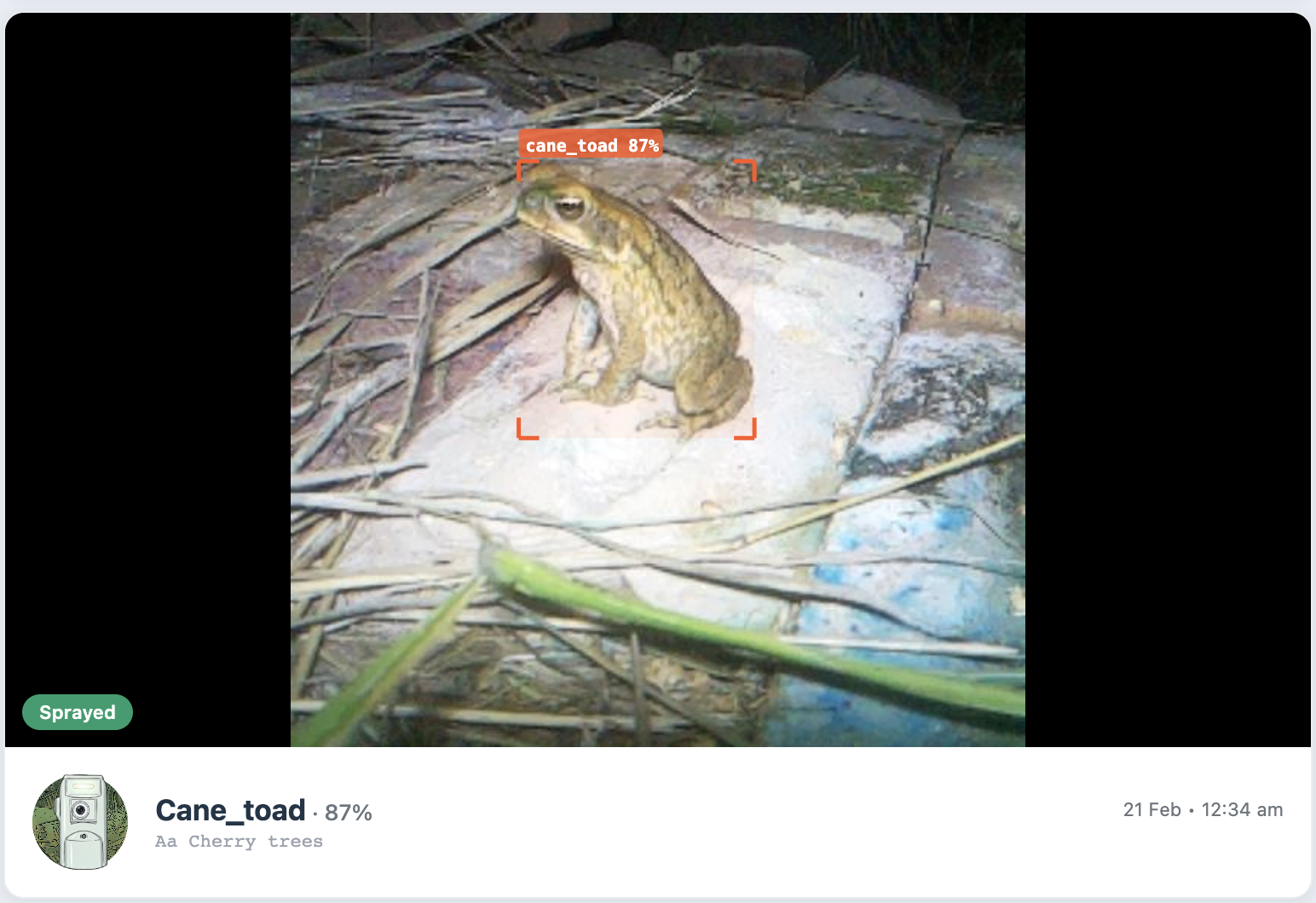
ToadTurret has a camera that captures images of the area in front of it. Every few seconds, each frame is run through an AI model that has been trained specifically to recognise cane toads. The model scans the image, identifies anything that looks like a toad, draws a box around it, and assigns a confidence score. Essentially, how certain the AI is that it is looking at a cane toad.
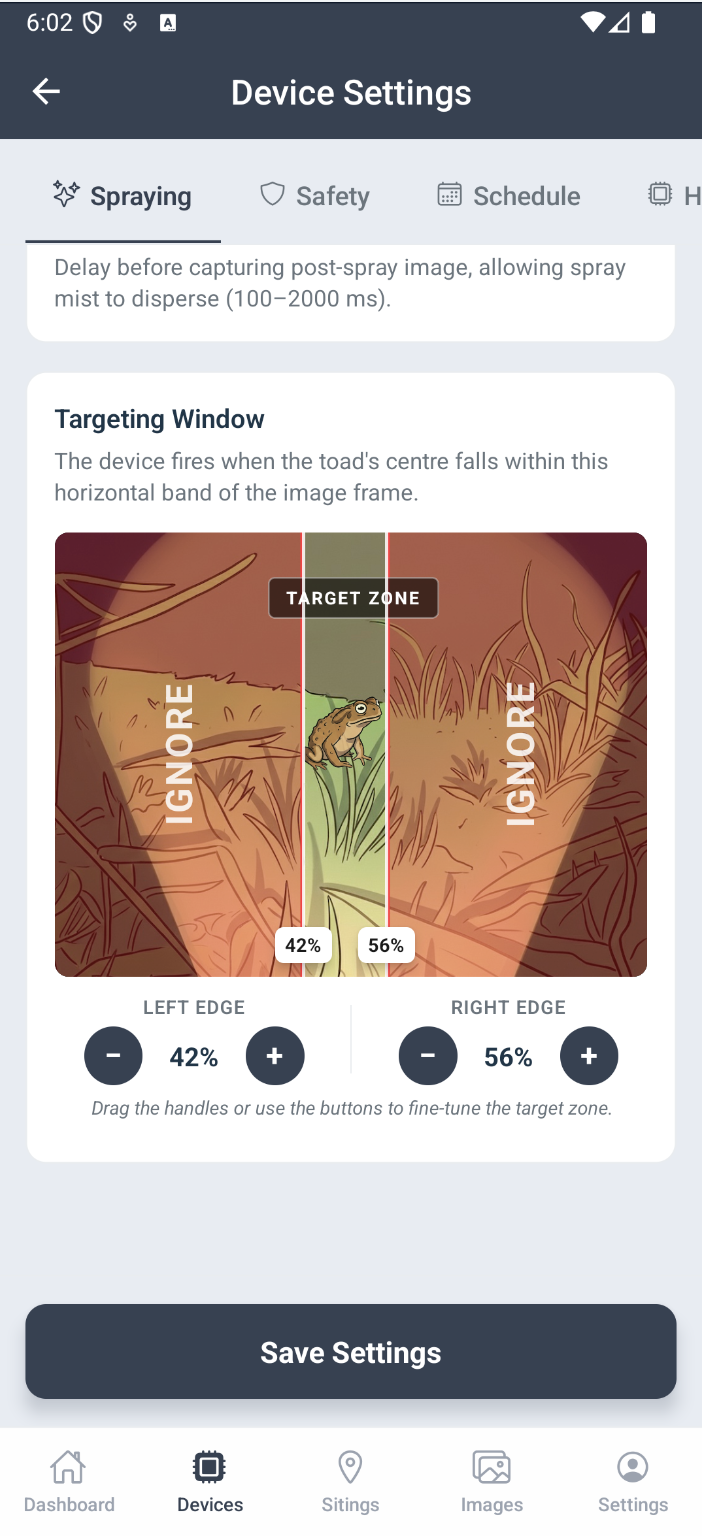
If the confidence is above a set threshold, the device takes action. If it is below the threshold, it does nothing. You can adjust this threshold yourself via the app or web dashboard, depending on how aggressive or cautious you want the system to be.
Here’s what that looks like in practice: real detections from the ToadOps app showing cane toads identified with bounding boxes and confidence scores.
Training the AI
The AI model did not come pre-loaded with toad knowledge. It had to learn, and that takes data. A lot of it.
We trained the model using thousands of real images of cane toads captured in the field. These images cover a wide range of conditions: different lighting, different angles, different backgrounds, wet nights, dry nights, toads sitting still, toads mid-hop. The more variety the model sees during training, the better it gets at recognising toads in new situations.
What the model learned to look for is a combination of features: body shape, size, skin texture, posture, and behaviour. It is not just matching against a single “toad template.” It has a general understanding of what makes a toad a toad.
We continue to improve the model over time. Every detection image captured by ToadTurret devices in the field is reviewed and can be used to retrain and improve future versions of the AI.
The Safety Net: Dual-Layer Verification
Getting the detection right is important. But the safety side is even more critical. The last thing we want is for the device to target a native frog or someone’s pet.
That is why ToadTurret uses a dual-layer verification system when connected to WiFi:
- Layer 1 (on-device): The device runs its own AI model locally. This is the first check, fast and immediate.
- Layer 2 (cloud): When connected to WiFi, the image is also sent to a cloud server that runs a second, independent AI model. This model is specifically trained to catch things the first model might miss.
If the cloud model detects something that is not a cane toad (a native frog, a pet, a bird, anything) the system immediately pauses. The safety pause gives nearby animals time to move on before the device resumes.
Without WiFi, the device still runs its on-device AI detection and safety checks. It just does not get the cloud second opinion.
The system is designed to err on the side of caution. When in doubt, it does nothing. We would rather miss a toad than accidentally target a native animal.
What It Can and Cannot Detect
Here is a simple breakdown:
- Cane toads: the primary target. The AI has been trained extensively on cane toad images and detects them with high accuracy.
- Native frogs: the system is designed to avoid spraying native frogs and activates a safety pause when one is identified. Misidentifications can still happen, particularly for species with limited training data. We’re working to improve accuracy as we collect more images.
- Pets (dogs, cats): detected and protected. The safety system kicks in immediately.
- Other wildlife: detected and protected.
- Shadows, leaves, objects: the AI has been trained to ignore these, though occasional false positives can occur in unusual lighting or conditions.
No AI is perfect and occasional misidentifications can happen in edge cases like unusual lighting or partially obscured views. The dual-layer system is designed to err on the side of caution when uncertain, but it is not foolproof. If you do spot a misidentification, you can report it directly from the app or dashboard. Reported images are reviewed by our team and fed back into the training data to improve the model.
Seeing in the Dark
Toads are nocturnal. They are most active after dark, which means the device needs to see in conditions where a standard camera would be useless.
ToadTurret uses a white light to illuminate the area in front of the camera. We tested infrared lighting early on, but found that it made it harder to distinguish between some native frogs and cane toads. White light gives the AI model much better colour and texture information to work with, which translates directly into more accurate detections.
Getting Smarter Over Time
One of the things we are most excited about is how the system improves over time.
Every detection image is stored on your dashboard for review. This growing library of real-world images feeds back into model improvement. When a new version of the AI model is ready, it is deployed to devices automatically via software updates. No action needed on your end.
As more ToadTurrets are deployed across different properties and environments, the training dataset grows. More data means better accuracy, better species distinction, and fewer false positives. The system genuinely gets smarter the more it is used.
Honest About Limitations
We believe in being upfront about what the AI can and cannot do.
- It is not perfect. Occasional false positives and false negatives happen. No AI system in the world achieves 100% accuracy.
- Unusual conditions can cause issues. Heavy fog, extreme glare, or unusual objects in the frame can sometimes confuse the model.
- Honest about limitations. Setting it too low may result in false positives. Setting it too high may mean some toads slip through. Finding the right balance for your property is part of getting the best results. Our best practices guide can help with that.
The dual-layer verification and cautious design significantly reduce the chance of misidentification, but no AI system is foolproof. There is always a possibility that a non-toad animal could be incorrectly identified. We are constantly working to improve accuracy, and the system is designed to err on the side of caution wherever possible.
Want to Know More?
If you have questions about how the detection works or want to share your own results, we would love to hear from you.
- Read our getting started guide if you are setting up a new device
- Check the best practices guide for tips on getting the most out of your ToadTurret
- Get in touch if you want to chat about the tech